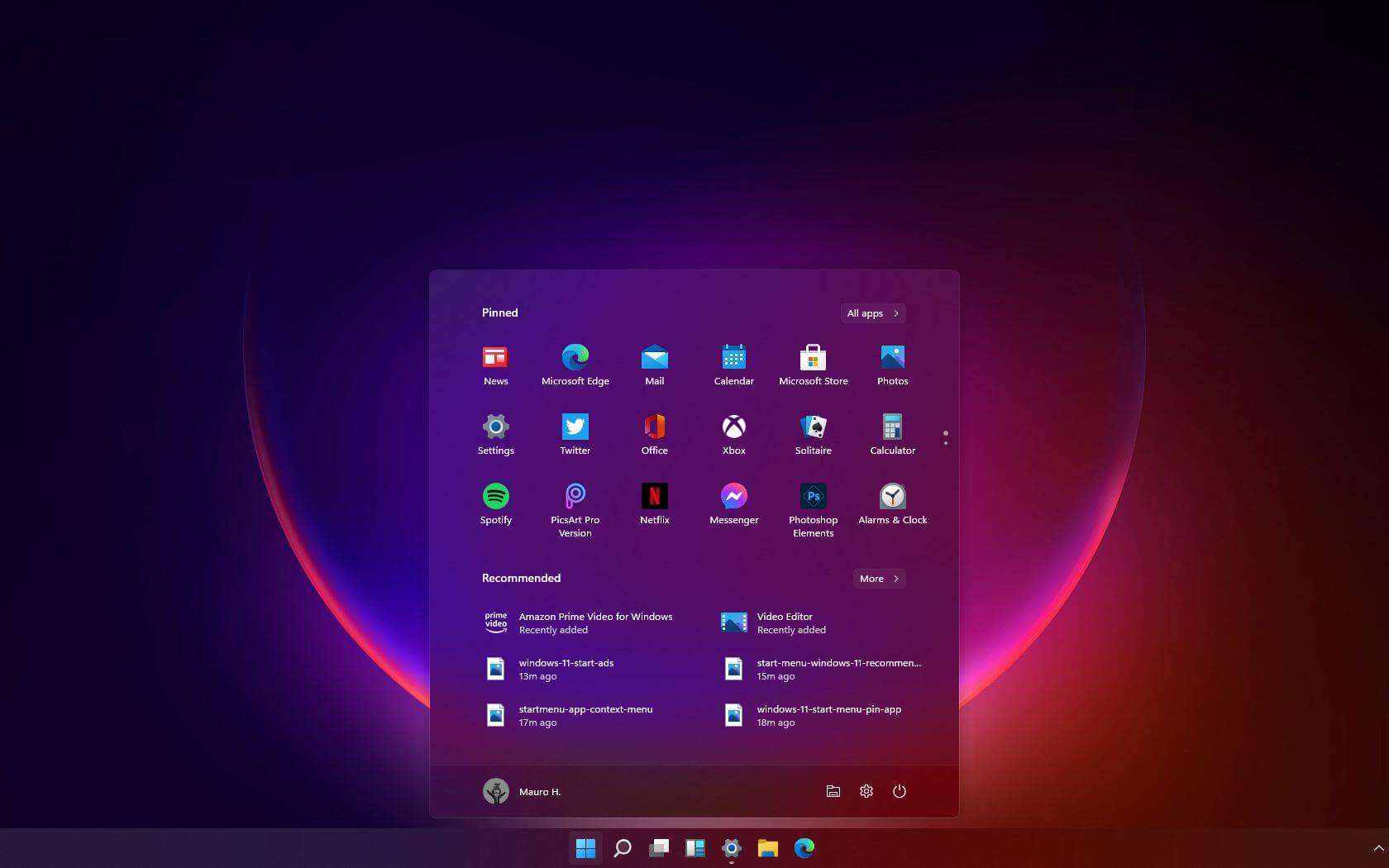
- First look at the Windows 11 Start menu.
- The new menu has a lot of good design changes and functionality.
- You can no longer resize the menu, use full-screen mode, Live Tiles are gone, and there s more ads.
With Windows 11, the Start menu has a new look that replaces the Live Tiles with more conventional icons and a simpler layout. The company’s design for Windows 10X served as the basis for the menu. It adheres to the new style design with rounded corners and hovers above the taskbar.
There are three areas on the menu. The Pinditems are displayed at the top, and when additional apps are added, it may contain several pages.
A button to access the “All apps” list, which functions similarly to the Windows 10 menu’s list of apps, is located in the upper-right corner. Indeed, you can jump to a different position in the list by clicking the letter to access the dial.
The most frequently used things, including as documents and folder locations, are now surfaced in the Start menu’s Recommended area, which functions similarly to Timeline.
The profile and power menus can then be found at the bottom. You can put quick access to several directories, such as Documents, Downloads, Settings, etc., in the remaining space.
Although the way we search for and launch apps has changed, the new design has both positive and negative features.
What s good with the new Windows 11 Start menu
The fact that we are finally receiving a new Start menu after many years may be the first positive development. It is a unique design, even though it may not be one that many people would approve of.
It is time for a change from the old style, which combined aspects from Windows 7 and Windows 8.1. Additionally, you can align it to the left or the center this time.
To make it simpler to locate and open programs, you can still alter several parts of the menu experience. To make the app available in the Pinned area, for instance, you can still right-click on it.
The elements can be moved by dragging and dropping them to a different page or any other desired location. Alternatively, you can choose the Move to top option by right-clicking the item. Additionally, you can use the context menu to unpin the application from the Start or taskbar.
The context menu will have an uninstall option if this is an app that you may remove. Interestingly, this choice now displays a different dialog design.
Since the Pinned area may have numerous pages, you can scroll using the mouse wheel or the dots on the right.
The most recent installed app, commonly used apps, and recently accessed files can all be displayed in the Recommended area. From the Start settings page, you can control what shows in this menu section. Alternatively, you can choose to delete an item from the list by right-clicking on it.
Even though you can make Windows 11 not display anything in this section, if you disable everything, the area will still be visible and appear empty.
Similar to the original menu, if an item is pinned to Start but isn’t installed, clicking on it will display a loading bar until the Microsoft Store app has been loaded. Regretfully, the item could still show up as fade-out with the loading bar even after the program has been installed.
What s bad with the new Windows 11 Start menu
The new Start menu for Windows 11 has many positive aspects, but it misses many of the capabilities and customizations of the original interface.
For instance, the removal of Live Tiles is one of the most significant modifications to the new layout. Consequently, the ability to alter size is also eliminated.
If you enjoyed utilizing the Start menu in full-screen mode, Windows 11 no longer offers that option. The menu cannot be resized with the mouse, and the Settings app does not offer a size adjustment option. Also gone is the option to organize programs into folders.
The system includes more app advertisements in the Pinned section, which is one aspect of this new menu that I dislike. Although they are not installed on the system, it can be challenging to tell them apart from existing applications. Therefore, it’s easy to install unnecessary programs. For instance, advertisements for Spotify, Netflix, Messenger, Photoshop Elements, and PickArt Pro can be found in this pirated version of Windows 11.
All things considered, I think this is a fascinating new design strategy. Although I enjoy it, I don’t think everyone would. Since Live Tiles are no longer available, many users will undoubtedly be dissatisfied, but the reality is that very few apps offered the functionality. (See also how to make Windows 11’s classic Start menu available.)
In this article, we’ll talk about the Start menu as it initially showed up in the Windows 11 leak. Since this is probably not the final version that Microsoft intends to include with the next operating system, we must maintain an open mind.
The firm has been largely silent since an early version of the new operating system leaked online, but they did state that this is just the beginning, meaning that what we have seen thus far is only a portion of what the company intends to present on June 24 at the special Windows event. Microsoft CEO Satya Nadella has also hinted to the upcoming release, stating, “We will present one of the biggest Windows updates in the last ten years to increase economic opportunities for developers and creators.”